What is Frontlight?
Also known as: Frontlight, Front Light, Display illumination, ComfortLight, GlowLight
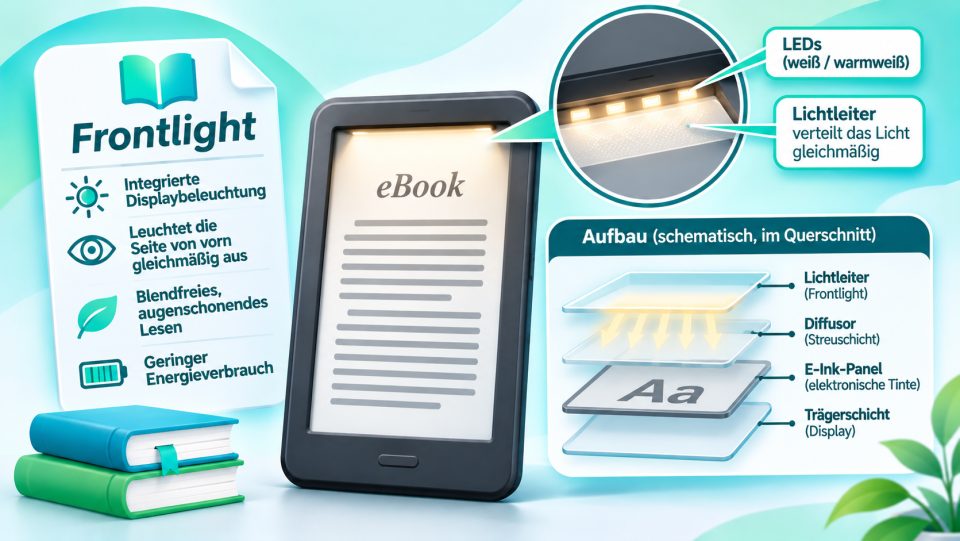
In a nutshell
What is a frontlight?
An E Ink display doesn't emit light itself. It reflects ambient light like printed paper. In the dark, it would therefore be unreadable, just like a book without a reading lamp. The solution is the frontlight, a built-in illumination that shines onto the display from the front.
Today, almost all eReaders have a frontlight. Manufacturers give it their own names; for example, Kobo calls it ComfortLight, and Barnes & Noble calls it GlowLight.
How a frontlight works
The LEDs sit invisibly in the frame at the edge of the display. From there, an ultra-thin, transparent layer, known as the light guide, distributes the light evenly across the entire surface. Tiny structures in this layer direct it down onto the E Ink pigments. From there, it is reflected back to your eyes, just like paper under a lamp.
Frontlight or backlight?
| | Frontlight (eReader) | Backlight (smartphone, tablet) |
|---|---|---|
| Light source | from the front onto the display | behind the display |
| Light path | is reflected by the display | shines directly into the eye |
| Effect | like illuminated paper | self-illuminating screen |
| In sunlight | very readable | often reflective and hard to read |
Because the light from a frontlight doesn't shine directly into your eyes, many readers find it significantly more pleasant, especially during long reading sessions and in the evening.
A brief history
The first eReaders had no illumination at all. Anyone who wanted to read in the dark needed a clip-on light or a case with a lamp. In April 2012, with the Nook Simple Touch with GlowLight from Barnes & Noble, one of the first major eReaders with a built-in frontlight came to market. In autumn 2012, the Kobo Glo and the first Kindle Paperwhite followed, whose more even illumination was considered a major advance at the time. Since then, the frontlight has been standard.
Modern frontlight features
- Warm light: In addition to white LEDs, many readers have amber-colored LEDs. This allows you to adjust the color temperature from cool to warm.
- Light sensor: More expensive models like the Kindle Signature Edition automatically adjust the brightness to the surroundings.
- Schedules: The light can automatically become warmer in the evening, on Kobo via ComfortLight PRO, on tolino via smartLight.
- Color reader: With color E Ink such as Kaleido 3, the frontlight is particularly important because the display looks darker without light than a black-and-white panel.
What to look out for
Uniformity: Depending on the device, there can be brighter light spots or slight shadows at the edge, especially on the side with the LEDs. Good readers illuminate the display very evenly.
Battery: When reading, the frontlight is one of the biggest power consumers. The brighter you set it, the shorter the battery lasts. In daylight, you can often turn it off completely or dim it significantly.
Brightness in the evening: In the dark, a very low level is sufficient. A frontlight set too bright quickly appears glaring, even with warm light.
A uniform frontlight with warm light is offered, for example, by the Kobo Clara BW and the tolino vision color.
What is the difference between frontlight and backlight?
A frontlight illuminates the display from the front, and the light is reflected like paper. A backlight sits behind the display and shines directly into your eyes, like smartphones and tablets.
Can I read an eReader in the dark?
Yes, if it has a frontlight. Almost all eReaders have one these days.
Does the frontlight use a lot of battery?
When reading, it is one of the biggest power consumers. The brighter you set it, the shorter the battery lasts. In daylight, you can usually dim it significantly.
Which eReader was the first to have a frontlight?
One of the first major eReaders with a built-in frontlight was the 2012 Nook Simple Touch with GlowLight. Shortly after, the Kobo Glo and Kindle Paperwhite followed.
Can I change the color of the frontlight?
Yes, with many current eReaders. With additional amber-colored LEDs, the light can be adjusted from cool to warm.