What is Kaleido 3?
Also known as: Kaleido 3, E Ink Kaleido 3, Kaleido, Color E Ink, Color E-Ink, Color E Ink, Color-eInk
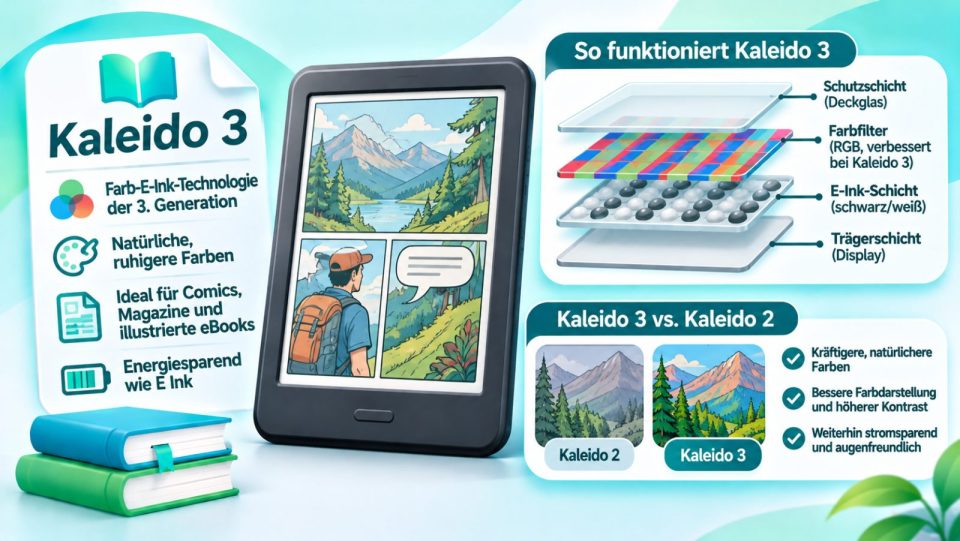
In a nutshell
What is Kaleido 3?
Kaleido 3 is a color display technology from manufacturer E Ink and is found in most current color eReaders. It brings book covers, comics, illustrations, and colored highlights to an E Ink display without losing the typical benefits: no flickering, good readability in sunlight, and a battery that lasts for weeks.
E Ink introduced Kaleido 3 in April 2022. The technology can display 4,096 colors and 16 shades of gray.
How does Kaleido 3 work?
At its core, Kaleido 3 is a completely normal black-and-white E Ink display with an additional color layer on top. This layer is called a color filter array (CFA) and consists of tiny red, green, and blue filter dots.
You can think of the principle like a colored mosaic glass over a black-and-white drawing:
- The E Ink panel underneath produces black, white, and shades of gray as usual.
- The color filter above colors the light reflected from the bright pixels.
- Several adjacent pixels with different filter colors blend together for your eye to form a color dot.
This is exactly what gives Kaleido 3 its most important characteristic: the display shows text and black-and-white content at 300 ppi, color only at 150 ppi. Several pixels are needed for one color dot, which is why the color resolution is halved.
What's new compared to older generations?
Kaleido 3 is the third generation after Kaleido and Kaleido Plus. According to E Ink, thanks to an optimized design, the colors are 30% more saturated than with Kaleido Plus.
| Generation | New feature |
|---|---|
| Kaleido | First generation of the color filter principle |
| Kaleido Plus | Improved color rendering |
| Kaleido 3 (2022) | 30% more color saturation, 150 ppi in color, ComfortGaze front light |
| Kaleido 4 (2026) | Double color gamut, 50% more contrast, reportedly 300 ppi in color |
Also new in Kaleido 3 is ComfortGaze, a front light that according to E Ink emits less blue light. Many readers with Kaleido 3 also let you adjust the color temperature, so you can read in the evening with warm, amber-colored light.
Strengths and weaknesses in everyday use
Kaleido 3 is a compromise: you get color, but pay for it with somewhat less contrast and brightness.
What Kaleido 3 does well:
- Colored book covers in the library
- Comics and manga as CBZ / CBR, children's books and cookbooks
- Graphics, charts, and maps in non-fiction books and PDFs
- Highlights and notes in different colors
What you should know before buying:
- Muted colors: The colors look more pastel like on newsprint, not vibrant like on a tablet.
- Darker background: The color filter absorbs light. The display therefore looks grayer than a pure black-and-white display, and you usually read with the light turned on.
- Slightly less text contrast: Text stays sharp at 300 ppi, but looks minimally paler next to a black-and-white reader.
- Shorter battery life: Because the light is almost always on, the battery lasts shorter than comparable black-and-white models.
- More ghosting: Image remnants from the previous page are often more visible through the color filter. A refresh after each page helps with image-heavy content.
Kaleido 3 or Gallery 3?
Alongside Kaleido 3, E Ink offers Gallery 3, a second color technology that works on a completely different principle. Instead of a color filter, Gallery 3 uses colored pigments directly in the display. This allows Gallery 3 to achieve 300 ppi in color as well, but it builds color pages significantly slower.
For eReaders, Kaleido 3 has prevailed because fast page turning while reading is more important than the highest color resolution.
The successor: Kaleido 4
On October 15, 2026, E Ink introduced Kaleido 4, the next generation. It specifically targets the weaknesses of Kaleido 3. Officially, E Ink states compared to Kaleido 3:
- Double the color gamut, so colors should become significantly more vibrant
- 15% brighter white tones, countering the gray background
- 50% more contrast
- Less graininess due to a redesigned display structure
- Video with up to 18 frames per second
- New color filter, new front light, and an oxide TFT backplane, i.e., a new way of controlling the pixels
However, the probably most important innovation is still missing from the official announcement: According to the specialist portal Good e-Reader, which E Ink supposedly confirmed, Kaleido 4 also shows color at 300 ppi, i.e., twice as fine as Kaleido 3. This would eliminate the biggest disadvantage of today's color eReaders.
The first device with Kaleido 4 is a note-taking tablet from Hanvon, which will initially only be available in China. In Europe, Kaleido 4 readers are expected no earlier than spring 2027. Until then, Kaleido 3 remains the technology in all current color eReaders you can buy here. All values so far come from the manufacturer; independent tests are still pending.
Which eBook readers use Kaleido 3?
Kaleido 3 is found in many current color eReaders, for example:
A special case is the Kindle Colorsoft. It also works with a color filter based on Kaleido technology and shows text at 300 ppi and color at 150 ppi. However, Amazon combines it with its own display structure, an oxide backplane, and nitride LEDs, and markets the whole thing under the name Colorsoft instead of Kaleido 3.
Who is Kaleido 3 for?
Kaleido 3 is worth it if color regularly appears in your reading routine: with comics, manga, cookbooks, travel guides, or if you like to highlight in color. If, on the other hand, you read almost only novels, you get more contrast, a brighter image, and longer battery life with a black-and-white reader, often for less money too.
If you don't urgently need a new device and color is important to you, it may be worth waiting for the first readers with Kaleido 4.
You can read in detail how color E Ink performs in everyday life in our guide Color E Ink explained: What Kaleido 3 can really do in daily life.
What is Kaleido 3?
Kaleido 3 is the third generation of E Ink's color E Ink technology. A color filter on top of a black-and-white display produces up to 4,096 colors without giving up the benefits of E Ink such as eye-friendliness and long battery life.
Why does Kaleido 3 have only 150 ppi in color?
The color filter combines several pixels into one color dot. Text and black-and-white content therefore appear at 300 ppi, color only at 150 ppi.
Is text on Kaleido 3 blurrier than on a black-and-white reader?
No, text remains razor-sharp at 300 ppi. However, due to the color filter it looks minimally paler, and the background is somewhat grayer than on a pure black-and-white display.
Why do the colors on Kaleido 3 look so pale?
The color filter absorbs part of the light, and E Ink doesn't emit light itself. The colors therefore look more pastel like on newsprint. With the front light turned on, they look significantly better.
What is the difference between Kaleido 3 and Kaleido 4?
Kaleido 4 was introduced in October 2026 and is said by E Ink to offer double the color gamut, 15% brighter white tones, and 50% more contrast. According to Good e-Reader, it also displays color at 300 instead of 150 ppi. Devices are expected in Europe from spring 2027.
Does the Kindle Colorsoft use Kaleido 3?
The Kindle Colorsoft is based on Kaleido technology with a color filter, but uses its own display structure from Amazon with an oxide backplane and nitride LEDs. Amazon therefore markets it under the name Colorsoft.