Ebook Piracy: Legal Risks, Shadow Libraries and Legal Alternatives
Ebook piracy means downloading or sharing copyrighted ebooks without permission. The rules differ by country, but downloading from illegal sources is risky almost everywhere, and large shadow libraries are being blocked in many places. This guide explains the risks and shows free and cheap legal ways to read, from public libraries to public domain classics.
This page has been translated from German.
One click and the new bestseller sits on your reader for free. Many download sites make it look that easy. This guide explains what ebook piracy really is, what the law says in different countries, how to spot illegal offers, and how to read plenty of books without breaking any rules.
What is ebook piracy?
Ebook piracy means copying, uploading, selling or downloading copyrighted digital books without permission from the author or publisher. In everyday talk it is often called theft. Legally it is copyright infringement through unauthorized copying and distribution. It affects novels as much as textbooks. Typical sources are torrents, forums and blogs with links to file hosts, messenger channels, and so-called shadow libraries: huge online archives that offer millions of books without a license.
Not every free download is illegal. In the EU and the UK, copyright generally lasts 70 years after the author's death, and after that a book is in the public domain. Other countries use other terms, so a title that is free in one country can still be protected in another. Many authors and publishers also give books away officially. What matters is not the price but whether the provider has the rights.
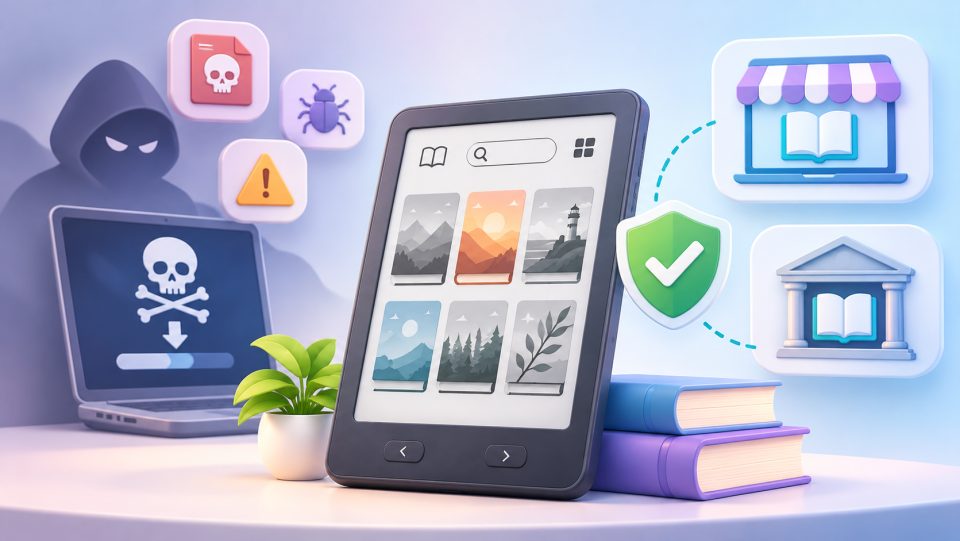
How do you spot a pirate site?
There is no guarantee, but these warning signs are fairly clear:
- Current bestsellers, completely free. Big publishers almost never give new releases away, apart from sample chapters.
- No imprint, no shop name, no publisher. Legitimate shops and libraries say who runs them.
- Downloads via file hosts, torrents or messenger groups instead of a shop or a library.
- Requests to "donate" or upload your own books to keep downloading.
- Aggressive ads, pop-ups and fake download buttons.
- Changing domains or notes like "new address". That is typical for blocked sites.
If several of these apply, stay away.
How common is ebook piracy?
Reliable global numbers do not exist, and national surveys are hard to compare. Two data points show the range:
- Anna's Archive says it offers more than 53 million books and over 37 million research papers for free (as of autumn 2025, according to its own figures).
- A Polish reader survey by the book portal lubimyczytac.pl and the Polish Chamber of Books found that about 25% of people who read ebooks and audiobooks admit to downloading from illegal sources. The survey also showed that people who read more ebooks use illegal sources more often, but most of them use legal sources too.
How big is the damage really?
Honestly, nobody can say exactly. Not every illegal download is a lost sale, because many people download books they would never have bought. Experts talk about the substitution rate: how many illegal downloads really replace a purchase. How high it is for ebooks is disputed in the book industry. What is clear: piracy hurts self-publishers and small presses most, because every sale counts for them, and new books can show up on illegal sites within days of release.
How do pirates make money?
Many "free" offers are a business. Site operators earn from ads, file hosts sell premium access for faster downloads, and some even reward uploaders for popular files. Some sellers offer pirated copies through classified ads or social networks. A real black market has grown around ebook piracy.
Is downloading pirated ebooks illegal?
In most countries, yes, at least when the source is obviously illegal. The details differ, so here is a rough overview. This is general information and not legal advice:
| Region | What the rules say | What can happen |
|---|---|---|
| EU | The Court of Justice ruled in 2014 (case C-435/12) that private copies must come from a lawful source | Civil claims; national criminal rules vary |
| Germany | Downloading from an obviously illegal source is not covered by the private copy exception (§ 53 UrhG) | Warning letters, damages, in extreme cases criminal proceedings |
| Poland | Distributing works without permission is a crime under Art. 116 of the copyright act, up to two years in prison in the basic case | Civil claims and criminal rules; distribution is treated much more severely than downloading |
| UK | Communicating copyright works online is a criminal offence, with a maximum of 10 years since the Digital Economy Act 2017 | Civil claims; the government said the maximum is meant for the most serious cases |
| USA | Civil statutory damages of $750 to $30,000 per work, up to $150,000 if the infringement is willful | Criminal penalties are possible for willful infringement, for example large-scale or commercial copying |
Two points surprise many readers. Owning the print edition does not give you a right to a free digital copy from an illegal source. And unlike a paperback, you cannot resell a purchased ebook as a used copy. The EU Court of Justice decided this in 2019 in the Tom Kabinet case.
What about torrents?
Risk is highest with torrents. While you download, you also share parts of the file with others, so your IP address becomes visible and rights holders or law firms can trace it through your provider. Direct downloads from file hosts are pursued less often, but they stay illegal. In practice, enforcement tends to focus on uploaders, sellers and site operators rather than individual readers. Operators often work anonymously from other countries, which makes cases harder.
If you receive a warning letter, do not sign a cease-and-desist declaration in a hurry. Have a lawyer who knows copyright law check it.
Z-Library, LibGen, Anna's Archive: why shadow libraries get blocked
Shadow libraries are the biggest trading places for pirated books. They offer millions of titles, usually through constantly changing domains.
- Z-Library: In November 2022 US authorities seized numerous addresses, and two alleged operators from Russia were arrested. The site keeps running through mirror addresses, and it even encourages users to run their own mirrors, which makes blocking harder.
- Library Genesis (LibGen): Around since about 2008 and best known for academic books.
- Anna's Archive: Appeared right after the Z-Library crackdown as a search engine across several shadow libraries.
Courts in many countries have ordered internet providers to block them:
- United Kingdom: The High Court ordered the major providers to block LibGen, Z-Library and Anna's Archive after an application by the Publishers Association.
- Netherlands: In March 2024 a Rotterdam court ordered a provider to block Anna's Archive and LibGen. A later order added Z-Library and OceanofPDF.
- Belgium: A Brussels court issued a broad order covering Anna's Archive, LibGen, Z-Library and OceanofPDF. It also named the Internet Archive's Open Library, but the order was paused for that domain.
- Italy and France: Anna's Archive was blocked in Italy in early 2024 after a complaint by publishers, and a French order against Z-Library dates from August 2022.
Blocks make casual access harder, but they are a cat and mouse game, and critics point out that this approach is not always transparent.
When AI companies use pirated books
Pirated books are not only an issue for individual readers. In 2024, US authors sued the AI company Anthropic for downloading books from shadow libraries such as LibGen and the Pirate Library Mirror to build its training data. A US judge held that training on legally acquired books can be fair use, but left the downloading and keeping of pirated copies for a jury. The parties then settled for $1.5 billion. The court granted final approval on 20 July 2026. The settlement covers 482,460 works, which comes to about $3,000 per work before fees and costs. Appeals against the approval have been filed. The case shows that even large companies can pay dearly for using illegal sources.
Does copy protection stop piracy?
Only partly. Hard DRM such as Adobe DRM or Amazon's Kindle DRM ties a purchased ebook to your account and devices. For experienced pirates it is no real obstacle. It mostly slows down honest buyers who want to read a book on another reader.
Many publishers therefore use a personalized watermark: your name or order number is hidden in the file. It does not limit how you read, but it shows where a file came from if it appears online. LCP is a newer, lighter DRM variant that libraries use, among others.
Why are ebooks not cheaper?
A common reason for illegal downloads is the feeling that ebooks cost too much. Print and shipping are only a small part of a book's price. Author fees, editing, translation and marketing apply no matter the format. Taxes play a role too: many countries have cut VAT on ebooks to match print. Poland moved from 23% to 5% in November 2019, and Germany went from 19% to 7% in December 2019. In Poland, prices did not fall right away. Libraries show the cost side clearly: a library often pays far more for an ebook license than a consumer pays for a copy, as we explain in our guide to library ebooks.
What can authors and publishers do against pirated copies?
If you find your own book on an illegal site, you have options:
- Request removal from the host. File hosts and platforms have to remove reported infringements (notice and takedown). A takedown notice is free.
- Inform search engines. Google and others remove reported links to pirated copies from search results.
- Involve your publisher or distributor. Many have anti-piracy teams or work with specialist agencies.
- Hire a service. For self-publishers there are paid services that scan the web for pirated copies and trigger removals.
- Use watermarks to trace the origin of a leak.
You cannot stop piracy completely this way, but every deleted copy makes illegal offers harder to find.
Why piracy is a bad idea for you too
Besides the legal risk there are very practical reasons to avoid dubious sites:
- Malware: Such sites often live on aggressive ads. Fake download buttons and supposed "reader apps" are a popular route for malware and subscription traps.
- Bad files: Pirated copies are often scanned PDFs or badly converted files with broken formatting, which is no fun on a 6 inch screen.
- No syncing: Reading progress, highlights and notes across devices only work with legal shops and services.
- Authors get nothing: Small presses and self-publishers live from every copy sold. If you like their books, buying secures the next ones.
Read legally and cheaply: the best alternatives
The good news: you do not need much money to read a lot legally.
| Option | What you get | Ideal for |
|---|---|---|
| Your public library | Borrow ebooks and audiobooks with a free or low-cost library card, see our guide to library ebooks | Heavy readers on a small budget |
| Public domain libraries such as Project Gutenberg | Nearly 79,000 free ebooks whose copyright has expired, as of early 2026 | Classics fans |
| Standard Ebooks | Carefully formatted and proofread editions of public domain classics | Readers who want polished files |
| Ebook subscriptions such as Kindle Unlimited | A large catalog for a monthly fee | Genre readers who read a lot |
| Samples, free promotions and daily deals | First chapters or full titles, officially free or discounted | Trying something new, saving money |
One caveat on public domain sites: Project Gutenberg follows US copyright law, so a small number of titles may not be public domain in your country. Check if you live elsewhere.
Which reader fits? Phones and tablets work with nearly every library app. Kobo readers like the Kobo Libra Colour support library borrowing in selected countries, and Kindle devices such as the Kindle Paperwhite read Kindle Store books. Your own DRM-free books reach any of them via sideloading, for example with Calibre. To keep track of everything you own, read our guide to the digital bookshelf.
Our verdict
Ebook piracy is not a harmless habit. Even if it is legally not theft in the strict sense, it directly hurts authors. Downloading from illegal sources is risky in most countries, big shadow libraries are being blocked, and even large companies have paid billions for using pirated copies. For you the risk is hardly worth it, because libraries, public domain classics and free samples give you more to read than you will ever finish, legally and cheaply.
Frequently asked questions
Is downloading a pirated ebook illegal?
In most countries, yes, at least when the source is obviously illegal. The EU Court of Justice ruled in 2014 that private copies must come from a lawful source. Penalties and enforcement differ by country, and this is general information, not legal advice.
How can I tell whether an ebook download is illegal?
Typical warning signs are current bestsellers for free, no imprint or shop name, downloads via file hosts, torrents or messenger groups, requests to upload your own books, aggressive ads and constantly changing domains.
Can I download an ebook for free if I own the print edition?
No. Owning the print edition does not give you a right to a free digital copy from an illegal source. Only the exceptions of your local copyright law apply, and they are narrow.
Why are sites like Z-Library and Anna's Archive blocked?
Because they offer millions of copyrighted books without a license. Courts in countries including the UK, the Netherlands, Belgium and Italy have ordered internet providers to block them, and US authorities seized Z-Library domains in 2022.
Where can I read ebooks for free and legally?
Use your public library with a library card, public domain libraries such as Project Gutenberg or Standard Ebooks, and official free promotions and samples from shops. Public domain rules differ by country.