What is Watermark (Soft DRM)?
Also known as: watermark, Soft DRM, soft DRM, soft copy protection, Social DRM, digital watermark, watermark DRM, personalized watermark
In a nutshell
What is a watermark for eBooks?
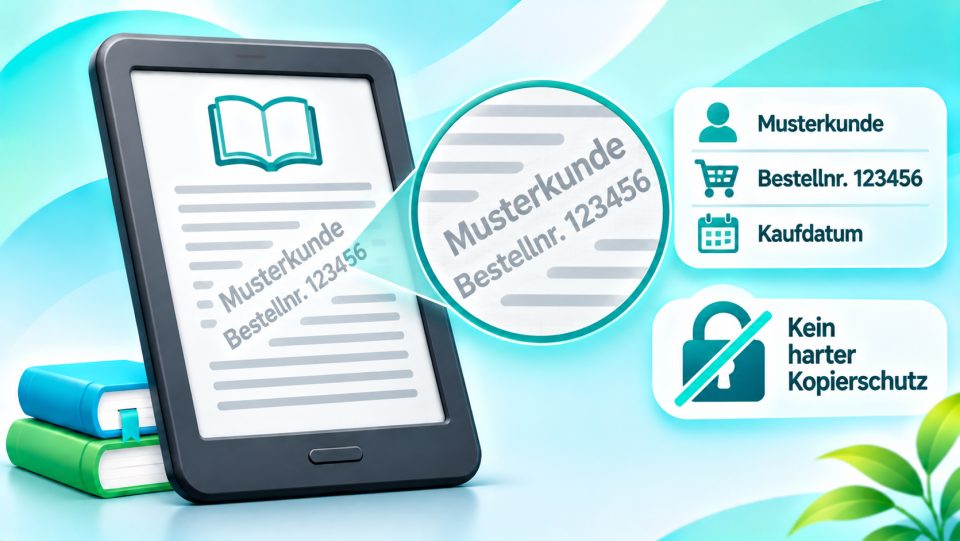
A digital watermark is a marking that is inserted into the eBook file at purchase. It reveals who bought the book, for example via your name, your email address, or a unique order number.
It is also called Soft DRM or Social DRM. Unlike hard DRM such as Adobe DRM or LCP, the watermark does not technically prevent anything. Instead, it relies on deterrence: anyone distributing a personalized book on the internet leaves their own traces.
How does a watermark work?
When you buy an eBook with a watermark, the shop creates a personal copy just for you. There are two types of marking, which are often combined:
| Type | What it looks like |
|---|---|
| Visible watermark | A note in the book, usually at the beginning or end, e.g. "This eBook was purchased for Max Mustermann" |
| Invisible watermark | Hidden data in the file, for example a transaction number that can only be read with special software |
For you as a reader, nothing changes: the book looks and reads like any other eBook.
There are even methods that slightly alter the text itself. SiDiM, developed in Germany, for example minimally varied punctuation and wording so that each sold copy is unique. However, such approaches have not become established.
Watermark or hard copy protection?
| Watermark (Soft DRM) | Hard copy protection (e.g. Adobe DRM, LCP) | |
|---|---|---|
| Protection principle | Deterrence through marking | Technical lock |
| Account required | No | Usually yes, e.g. a ByteBooks ID |
| Read on multiple own devices | Yes, without restriction | Only on authorized devices |
| Manage or convert with Calibre | Yes | No |
| Readable on Kindle | Yes, via Send to Kindle | No |
| If the shop closes | Books remain readable | Problems possible depending on the system |
So the watermark has almost only advantages for you: you can read the book on all your devices, back it up, and continue to use it in the future without depending on a specific provider or software.
How widespread is Soft DRM?
In Germany, the watermark is very widespread today. Many large publishing groups such as Holtzbrinck, Bonnier, dtv, Hoffmann und Campe, Lübbe, and Random House switched from hard DRM to watermarks years ago. Self-publishing service providers also offer the watermark as a protection option.
In many shops, the copy protection is stated directly in the product description, for example as "Copy protection: Watermark" or "Watermark DRM". It is worth checking before purchase because it determines which devices you can read the book on.
Exceptions are the large platforms with their own ecosystem: books from the Kindle Store or the Kobo Store usually carry the copy protection of the respective provider.
Which eReaders do eBooks with watermarks work on?
eBooks with watermarks are usually normal EPUB or PDF files and therefore work on practically all eReaders:
- tolino, Kobo, and PocketBook: directly via USB, cloud, or email, i.e. via Sideloading. Examples include the tolino vision color and the Kobo Libra Colour.
- Kindle: You send EPUB files with watermarks to your reader via Send to Kindle, for example the Kindle Paperwhite. Amazon converts them automatically.
- Smartphone, tablet, and computer: with any common eBook app.
What is allowed and what is not?
A watermark does not make an eBook a freely distributable book. What is allowed is governed by copyright and the shop's terms:
- Allowed: reading the book on your own devices, making a backup copy, and converting it to another format with Calibre
- Not allowed: uploading the book, sharing it publicly, or reselling it
- Removing the watermark: Removing rights management information is generally also not allowed under German copyright law
Whether you may pass on an eBook with a watermark within the family depends on the terms of use of the respective shop.
Who benefits from the watermark?
The watermark is ideal for anyone who does not want to be tied to an ecosystem. If you shop at different stores, use multiple devices, or want to manage your library yourself in the long term, eBooks with watermarks are the most flexible choice. Simply check the copy protection information when purchasing.
What is a watermark for eBooks?
A watermark is a soft copy protection. The eBook is marked with buyer details at purchase, such as name or order number. You can still read it on any compatible device without an account or activation.
What is the difference between a watermark and DRM?
Hard DRM such as Adobe DRM or LCP technically blocks opening and only allows it on authorized devices. A watermark does not block anything, but marks the book so that it can be traced in case of unauthorized distribution.
Can I read eBooks with watermarks on Kindle?
Yes. Send the EPUB file to your reader via Send to Kindle. Amazon automatically converts it into a Kindle format.
May I pass on eBooks with watermarks?
No, sharing publicly or reselling is not allowed. Whether passing it on within the family is allowed depends on the shop's terms of use. However, you may read and back up the book on your own devices.
How do I recognize if an eBook has a watermark?
Most shops state the copy protection in the product description, for example as "Copy protection: Watermark". You can often also find a visible watermark at the beginning or end of the book.