What is eBook?
Also known as: eBook, E-Book, Ebook, eBooks, E-Books, electronic book, digital book
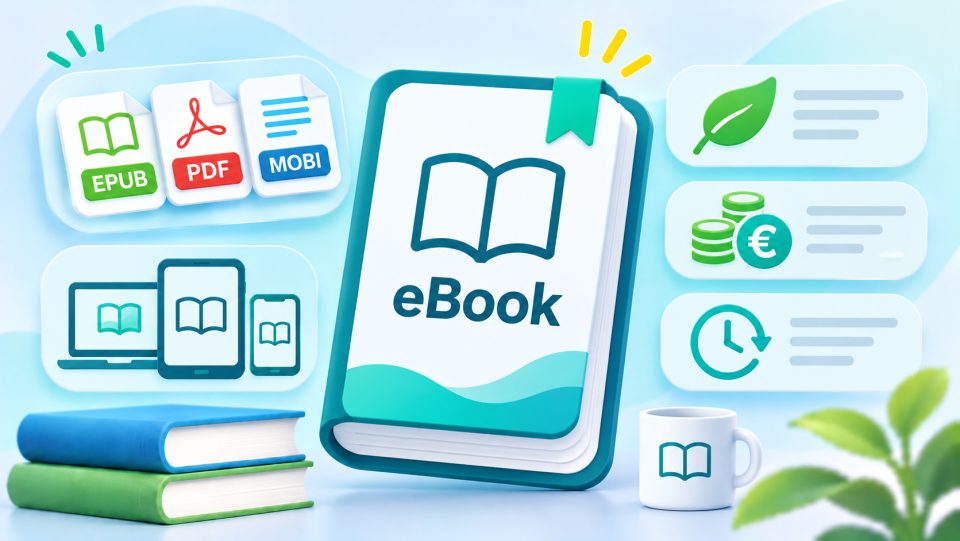
In a nutshell
What is an eBook?
An eBook is a book that exists as a file instead of on paper. It contains the same text as the printed edition, often along with a cover, images, and a table of contents, but it is not tied to a fixed page: you set font size, typeface, line spacing, and margins yourself, and the text reflows. An 800-page tome weighs exactly as much as your reader when stored digitally.
You can use digital books on three kinds of devices:
- eBook readers with E Ink screens that read like paper and go for weeks without a power outlet
- Smartphones and tablets with a reading app like Kindle, Kobo, or Apple Books
- Computers with programs like Calibre, Thorium Reader, or Adobe Digital Editions; long texts are less relaxing to read on a computer screen, though
The spelling is not standardized, by the way: eBook, E-Book, and Ebook all mean the same thing. The Duden recommends "E-Book"; in the market, "eBook" has prevailed.
How is an eBook built technically?
At its core, a typical eBook is a small website in a suitcase. An EPUB file is a ZIP archive containing:
- the chapters as XHTML files, i.e. the same technology as websites
- stylesheets (CSS) for the layout
- images and embedded fonts
- a package file (OPF) with title, author, language, and the order of the chapters
- a table of contents for navigation
Rename an .epub file to .zip and you can look inside. Exactly this open structure makes the format so flexible: every device can render the text by its own rules.
Reflowable text or fixed layout?
| Reflowable text | Fixed layout | |
|---|---|---|
| Typical for | novels, nonfiction, guides | picture books, cookbooks, comics, textbooks |
| Font size | freely adjustable | fixed, zoom only |
| Page count | depends on device and settings | matches the print edition |
| Good on small readers | yes | rather no, better on large or color displays |
A PDF is a special case with a fixed layout: it reproduces the printed page exactly and is often tedious to read on 6-inch readers.
Which eBook formats are there?
| Format | What it is for | Who uses it |
|---|---|---|
| EPUB | open standard, the normal case | Kobo, PocketBook, Apple Books, Onleihe, and many more |
| AZW3 / KFX | Amazon's own formats | Kindle |
| MOBI | older Amazon format | being phased out |
| documents, specialist books | all devices, with limitations | |
| CBZ / CBR | comics and manga | many readers and apps |
Which file format a shop delivers is stated on the product page. An in-depth comparison of all formats can be found in the guide eBook-Formate erklärt: EPUB, PDF, AZW3 und Co..
The history of the eBook
The vision: reading machines before the computer
The idea is older than any screen. As early as 1930, the American writer Bob Brown dreamed of a reading machine called "The Readies" that would run text past on a ribbon. In 1949, the Spanish teacher Ángela Ruiz Robles filed a patent for her "Enciclopedia mecánica", a mechanical reading machine with interchangeable text rolls so her pupils would not have to carry so much around.
1971: the world's first eBook
July 4, 1971 is considered the moment of birth. The student Michael Hart typed the US Declaration of Independence, about 1,300 words, into a Xerox Sigma V mainframe at the University of Illinois and made it available to everyone free of charge. From this grew Project Gutenberg, the world's oldest digital library. Until 1989, Hart transcribed works by hand; only better scanners and text recognition sped up the work. Today the project comprises more than 70,000 public-domain works.
1990s: CD-ROMs, PDAs, and the first reading devices
In the 1990s, books migrated to CD-ROMs, Sony's Data Discman, and PDAs like the Apple Newton. In 1998, the Rocket eBook and the SoftBook Reader brought the first true reading devices to market. They failed because of high prices, a small catalog, and LCD screens that tired the eyes.
2007: the breakthrough
Two events made 2007 the turning point. The International Digital Publishing Forum released EPUB as an open standard, and Amazon launched the first Kindle, which could load titles from its own shop over the cellular network in seconds. Only the combination of a comfortable E Ink display, a large catalog, and one-click buying made the digital book mainstream. EPUB 3 followed in 2011 with audio, video, and better accessibility; since 2017 the standard has been developed at the W3C.
The eBook in Germany
| Year | Milestone |
|---|---|
| 2007 | the Onleihe starts digital lending at libraries |
| 2011 | Amazon opens the German Kindle store |
| 2013 | Thalia, Weltbild, Hugendubel, and Deutsche Telekom found the tolino alliance |
| 2016 | fixed book pricing explicitly covers digital editions too |
| 2017 | Rakuten Kobo takes over the alliance's technology platform from Deutsche Telekom |
| 2019 | the VAT rate drops from 19 to 7 percent, as with print editions |
| 2019 | the ECJ prohibits reselling "used" titles without permission |
| 2025 | accessibility becomes mandatory for new releases |
| 2026 | for the first time, more than half of Germans read digitally |
How big is the eBook market?
The eBook has reached the middle of society but has remained a niche in terms of revenue. According to Bitkom, in 2026 a total of 55 percent of people aged 16 and over read digitally at least occasionally; among those over 65 the figure is 42 percent. Most read both, though: only 4 percent read exclusively digitally.
In money terms, the picture is more sober. In 2025 the share of the German consumer market was 6.3 percent:
| Figure for 2025 | Value |
|---|---|
| Revenue | around 261 million euros |
| Copies sold | 37.2 million |
| Average price | 7.01 euros |
| Share of fiction | around 88 percent |
The digital format is therefore mainly a medium for novels, especially for heavy readers of crime, fantasy, and romance. You can find all the figures in our analyses of E-Book market development and the Bitkom survey 2026.
Where do you get eBooks?
Digital titles are available in online shops such as Thalia, Hugendubel, Kobo, or the Kindle store, and directly from some publishers. After purchase, you download the title in the app or on your eReader via Wi-Fi, or save the file on your computer. Beyond that, there are other platforms and providers with their own models:
- Flat-rate subscriptions like Kindle Unlimited or Skoobe offer reading material from a fixed catalog for a monthly fee.
- Ad-funded apps like Readfy offer free titles with ad insertions.
- Libraries provide digital titles through the Onleihe, usually covered by the annual fee. How that works is explained in the guide E-Book libraries in Germany.
- Deal newsletters report discounted and free titles daily, sorted by reading taste.
Which option suits you depends on how much you read. A flat rate mainly pays off if you get through several books a month and find yourself at home in the catalog.
Comparison: eBook or printed book?
| eBook | Printed book | |
|---|---|---|
| Weight | thousands of books on one device | every book individually |
| Price | usually slightly cheaper than the hardcover due to fixed book pricing | fixed retail price |
| Type | font size and typeface freely adjustable | fixed |
| Reading in the dark | on a reader with lighting | only with a lamp |
| Features | search, dictionary, highlighting built in | pen and sticky notes |
| Lending, gifting, reselling | barely possible | at any time |
| Ownership | usually just a license | belongs to you |
| Availability | instant, around the clock | bookstore or shipping |
Practical questions: what buyers should know before purchasing
Can I read eBooks on several devices?
Yes, usually on all devices signed in to the same account, such as your reader, smartphone app, and tablet. Reading progress is synced by Cloud Sync. With Adobe DRM, the number of authorized devices is limited.
Do I have to be online to read?
No. You only need internet for buying, downloading, and syncing. A downloaded title can be read offline, on a plane or in a dead zone. Exceptions are titles that a provider only offers for reading in the browser.
Can I return a purchased eBook?
Usually only to a limited extent. For digital content the right of withdrawal usually lapses as soon as the download begins and you have explicitly agreed beforehand. Some shops take back accidental purchases as a courtesy.
Can I gift or lend an eBook?
Many shops offer a gift function or vouchers. You may not pass the file itself on. Some providers allow sharing within the family, for example tolino with Family Sharing.
Can I print or copy eBooks?
Usually not for titles with copy protection, or only in short excerpts. Copyright law allows private copies only if no protection is circumvented.
How long can I use an eBook?
Indefinitely, as long as the account and the provider continue to exist. If a shop is shut down, access to protected titles can become difficult. For that case it is best to additionally back up unprotected files on your computer, as described in the guide Digitales Bücherregal.
Is every book available as an eBook?
No. Whether there is a digital edition is decided by publishers and by the authors as rights holders under copyright law. For new releases the digital version usually appears at the same time; for older titles and coffee-table books it is often missing.
Why can I buy some titles only in certain countries?
Publishers often grant usage rights separately by country and language. A shop may therefore sell a title only where it holds the rights.
How much storage does an eBook need?
A novel without images usually takes up only one to a few megabytes. Coffee-table books, comics, and PDFs are considerably larger. A reader with 16 GB holds thousands of novels.
What is an ACSM file?
If, after a purchase, you download a small ACSM file instead of an EPUB, the title is protected with Adobe DRM. The ACSM is only a voucher that you convert into the actual eBook with Adobe Digital Editions.
Can I read titles from other shops on a Kindle?
Not titles with Adobe DRM or LCP. Unprotected EPUB files, or files with a watermark, can be transferred via Send to Kindle.
Good to know: rights, prices, and copy protection
You usually buy a usage right, not a book
When you buy an eBook, legally you usually acquire a usage right. You may therefore not simply resell a copy you have read. The European Court of Justice ruled on this on December 19, 2019 in the case of the Dutch company Tom Kabinet. A second-hand market like the one for print editions is therefore not possible.
Copy protection decides where you can read
Many titles are protected with DRM. A Kindle book runs only at Amazon; a title with Adobe DRM or LCP runs on tolino, Kobo, or PocketBook. Files with a watermark or entirely without protection can be transferred to almost any device via sideloading and managed with Calibre. Removing effective copy protection is prohibited under German copyright law, even for purchased titles.
The same price in every shop
Since September 2016, fixed book pricing has also applied to digital editions. Publishers set a fixed retail price that applies in the big online shop just as much as in the small book store. Comparing prices between shops is therefore not worthwhile, but publishers' promotions are. Exceptions are titles from self-publishers, who set their own prices, and foreign-language editions.
Reading legally for free
- Library: with the Onleihe you borrow using your library card.
- Classics: public-domain works whose authors have been dead for more than 70 years are available free, for example at Project Gutenberg.
- Promotions: shops and self-publishers regularly give away titles.
Stay away from illegal download sites: our guide eBook piracy: facts, risks & legal alternatives explains why.
Accessibility is now mandatory
Since June 28, 2025, newly released digital editions in the EU must be accessible; in Germany this is regulated by the Barrierefreiheitsstärkungsgesetz (Accessibility Strengthening Act). This includes a clean structure, image descriptions, and support for screen readers and the read-aloud feature.
Be careful with AI books
On self-publishing platforms, the share of AI-generated titles is growing fast. A study of genre titles on Kindle Direct Publishing found more than 25 percent AI text in about one in five titles. A look at the sample is therefore worthwhile.
For whom are eBooks worth it?
Digital books pay off for everyone who reads a lot, is often on the road, likes reading in bed or on vacation, or needs a larger font. Heavy readers of novels and series benefit in particular: the next book is there within seconds, for every reading taste, and a reader fits into any jacket pocket. If you read a lot, you save extra money with a flat rate or the Onleihe. If you like lending, collecting, or reselling, you are better served with paper. Many do what most Germans do and use both.
[Editorial test impression: our own experiences with eBooks in everyday reading]
What is an eBook?
An eBook is a book in digital form. You read it on an eReader, smartphone, tablet, or computer. Most titles come in the EPUB format, whose text adapts to any screen size.
Are eBooks cheaper than printed books?
Usually slightly cheaper than the hardcover. Due to fixed book pricing, an eBook costs the same in every German shop. Exceptions are titles from self-publishers and foreign-language editions.
Can I read eBooks on several devices?
Yes, usually on all devices signed in to the same account, such as reader, smartphone, and tablet. Reading progress is synced via Cloud Sync. With Adobe DRM, the number of devices is limited.
Do I have to be online to read eBooks?
No. You only need internet for buying, downloading, and syncing. A downloaded eBook can be read offline, for example on a plane.
Can I return a purchased eBook?
Usually only to a limited extent. For digital content the right of withdrawal generally lapses once the download begins, if you have agreed beforehand. Some shops take back mistaken purchases as a courtesy.
Do I own an eBook I purchased?
Usually not in the legal sense. You generally acquire a usage right. According to a 2019 ECJ ruling, you may not resell eBooks you have read without permission either.